What taxes does a company in the Republic of Moldova pay in 2026?


09.01.2026
If you’re about to start a business in the Republic of Moldova, you’re probably wondering:

- What taxes and fees do I have to pay?
- What is most advantageous for my industry?
- How can you optimize taxes legally ?
In Moldova, every business contributes through taxes to the public budget (education, healthcare, infrastructure, etc.). With the right information, you can choose the right tax regime and avoid paying more than necessary. The answers here aren’t just theory. Let’s go through each regime with practical examples, so you understand how much money you actually keep.
Which legal form should I choose: ÎI, SRL, SA, NGO, IT Park?
Sole Proprietorship / Individual Enterprise (ÎI)
The simplest way to start — where you and your business are essentially the same person.
Advantages:
- You can withdraw money from the business without paying dividends.
- Good for businesses such as small shops or small-scale production with modest turnover.
- Easy to close: you submit just one application to ASP.
Disadvantages:
- You are personally and unlimitedly liable for the business’s debts (you can lose personal assets).
- It cannot be sold as a legal entity.
- You cannot attract investors.
- Health insurance contributions are paid separately, annually, even if you have no activity.
- If you are not employed elsewhere, you must pay social contributions which for 2026 are approximately 1,907 MDL/month, regardless of whether the business is active or has absolutely no activity.
What taxes and fees apply to an Individual Enterprise (ÎI)
- Simplified regime — not a VAT payer (12% of profit)
- VAT payer regime (12% of profit + 20% VAT) — if you exceed the threshold of 1.5 million MDL/year or choose to become a VAT payer.
note: Profit = Revenue − Expenses
Practical example:
You run a small carpentry workshop and you are not employed elsewhere.
Each month you earn the equivalent of $3,000 (≈ 54,000 MDL) in revenue. Expenses (materials, rent, energy): 24,000 MDL.
- Profit = 30,000 MDL (54,000 − 24,000).
- Income tax 12% (30,000 × 12%) = 3,600 MDL.
- Social contributions = 1,907 MDL/month (if you’re employed elsewhere, you don’t pay this contribution)
Final result
From a monthly profit of 30,000 MDL, you pay:
- 3,600 MDL income tax on profit.
- 1,907 MDL — social contributions.
👉 You keep about 24,493 MDL net for yourself.
An ÎI is suitable for small businesses, individual services, or freelancers with modest income, where you don’t need partners and you accept personal risk. But if income grows or you want legal protection, switching to an SRL becomes much more advantageous.
Limited Liability Company (SRL)
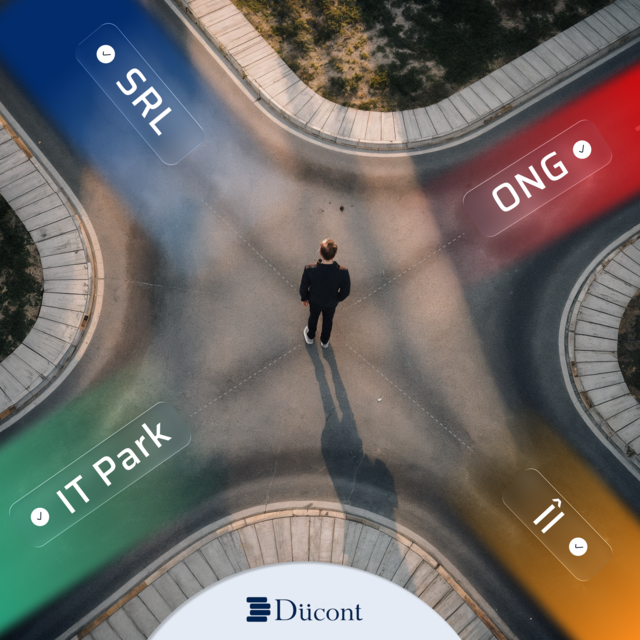
The SRL is the most popular legal form for business in Moldova. The company has a separate legal personality — meaning it is the company that is liable for debts, not you as an individual.
An SRL can be taxed in two ways:
- Simplified regime — not a VAT payer (4% of revenue) — if you do not exceed 1.5 million MDL over the last 12 months and you are not a VAT payer.
- Standard regime — VAT payer (12% of profit + 20% VAT) — if you exceed the threshold or choose to become a VAT payer.
1. SRL — Simplified regime — not a VAT payer (4% revenue tax)
What you must pay:
- Revenue tax — 4% of all company revenues, regardless of expenses.
- Payroll taxes — you pay about ~45%–50% on top of the net salary, i.e., on top of what the employee receives “in hand”.
- Dividend tax — 6% on money distributed from the company (you decide when to withdraw it).
Practical example
You have a small construction SRL with revenues of 54,000 MDL/month. You have 3 employees, each with a gross salary of 10,000 MDL, and transportation/other costs of 5,000 MDL/month.
Step 1: Revenue tax — 4% × 54,000 = 2,160 MDL
Step 2: Employees and payroll-related taxes
For each of the 3 employees:
- Gross salary: 10,000 MDL.
- Health insurance (9%) = 900 MDL (withheld from the employee).
- Income tax (12%) = 795 MDL (withheld from the employee).
- Net salary = 10,000 − 900 − 795 = 8,305 MDL.
For 3 employees, total net = 3 × 8,305 = 24,915 MDL
Step 3: Company expenses + taxes.
- Revenue tax (4%) = 2,160 MDL.
- Total gross salaries = 30,000 MDL.
- Social fund (24% × 30,000) = 7,200 MDL (paid by the company).
- Other expenses (transport, utilities, small materials, etc.) = 5,000 MDL
Total expenses: 2,160 + 30,000 + 7,200 + 5,000 = 44,360 MDL.
note: For more detailed salary calculations you can use → salary calculator
Step 4: Profit after expenses, salaries and taxes.
- Total revenue — 54,000 MDL
- Total expenses — 44,360 MDL
- Profit = 54,000 − 44,360 = 9,640 MDL
Step 5: Withdrawing money & dividend taxation.
If you want to withdraw money from the company, at the end you pay the final 6% tax on dividends.
In our example: 9,640 MDL × 6% = about 579 MDL tax.
👉 After this payment, you have 9,061 MDL left, which represents your personal money — the amount you can effectively withdraw.
The simplified regime is good for companies with low expenses. But if you have high costs (raw materials, equipment), you may end up paying tax even on amounts that are not real profit.
2. SRL — Standard regime — VAT payer (12% of profit)
What you must pay:
- Corporate income tax — 12%, where Profit = Revenue − Expenses.
- Payroll taxes — about ~45%–50% on top of net salary, same as in the simplified regime.
- Value Added Tax — VAT 20% — your company collects VAT from customers, deducts VAT paid to suppliers, and pays only the remaining difference to the state.
- Dividend tax — 6% on money distributed from the company (you decide when to withdraw it).
Practical example:
We use the same example as for the SRL simplified regime (non-VAT payer).
Step 1: Salaries and employee withholdings.
For each employee:
- Gross salary = 10,000 MDL.
- Health insurance (9%) = 900 MDL (withheld from the employee).
- Income tax (12%) = 795 MDL.
- Net salary = 10,000 − 900 − 795 = 8,305 MDL.
For 3 employees, total net salaries = 24,915 MDL.
Step 2: Company costs for employees.
The company pays total gross salaries (30,000 MDL) + 24% social fund (7,200 MDL).
So total employee cost = 37,200 MDL.
Step 3: Calculate VAT payable.
- Revenue = 54,000 MDL (45,000 + 9,000 VAT collected).
- Expenses = 5,000 MDL (4,167 + 833 VAT paid).
So, VAT collected − VAT paid = 9,000 − 833 = 8,167 MDL (VAT to be paid to the state).
Step 4: Calculate the company’s gross profit (before tax).
- Profit = Revenue without VAT − Expenses without VAT − Salaries − Social fund.
- Calculation: 45,000 − 4,167 − 30,000 − 7,200 = 3,633 MDL (profit).
Step 5: Calculate corporate income tax — 12%.
- Corporate income tax = 3,633 × 12% = 436 MDL.
Step 6: Calculate the company’s net profit.
- Net profit = Revenue − Expenses − Salaries − VAT − Social fund − Corporate income tax.
- Calculation: 54,000 − 5,000 − 30,000 − 8,167 − 7,200 − 436 = 3,197 MDL (net profit).
Step 7: Calculate dividend tax.
- Dividend tax = Net profit × 6% = 3,197 × 6% = 192 MDL.
- Dividends to founders = 3,197 − 192 = 3,005 MDL.
👉 In total, the founders received 3,005 MDL from the company’s profit as dividends for that month.
The standard 12% profit tax regime is advantageous for companies with high expenses (salaries, raw materials, rent, equipment) because these costs are deducted before calculating corporate income tax. This way, you pay 12% only on the real profit left after expenses, not on gross revenue like in the micro regime (4%).
In addition, if the company is a VAT payer, you can also deduct VAT paid to suppliers from VAT collected from customers. You can read more about VAT here.
👉 In conclusion, the standard regime is convenient for
- Companies with large and recurring expenses (e.g., construction, production, goods trading).
- Businesses that work with VAT-paying clients.
- Companies exporting goods or services abroad.
For businesses with low expenses and high profit margins, the micro regime (4% of revenue) can be more advantageous. In both cases, salaries are a major cost and must be planned carefully. Note: for owners, dividends are often more tax-efficient than salaries.
You can use our salary calculator to estimate what salaries you can offer and what taxes you need to pay for employees.
Joint Stock Company (SA)
If an SRL is like a family car—perfect for most trips—an SA is like a private jet: ideal for going far, fast. A joint stock company is for already large businesses that need significant capital and want to attract hundreds or even thousands of investors.
How it works:
- From a tax standpoint, an SA operates practically the same as a large SRL.
- The main difference is governance (more transparency, more complex reporting) and the ability to attract many shareholders by issuing shares.
Why switch to an SA?
The main reason is to raise money from a large number of investors. An SA splits ownership into shares, which it can sell publicly. When an SA is “listed on the stock exchange”, its shares are offered on a public market. Anyone can buy a share and become a small owner of the company. This allows the company to quickly raise the funds needed to grow.
Company with Foreign Capital (ICS)
An ICS is not a different type of company — it is simply an SRL or an SA that has foreign shareholders (non-resident individuals or companies, i.e., from other countries).
How it works:
- ICS is not a separate legal form, but an SRL/SA owned (partly or fully) by foreign investors.
- Tax-wise, it pays the same taxes as an SRL.
- Differences may occur for dividends paid to non-residents, where taxation depends on the double taxation treaties between the Republic of Moldova and the investor’s country (foreign founder).
👉 Conclusion: an ICS has the same obligations as a local SRL/SA, but foreign investors may pay a lower dividend tax (e.g., 5% instead of 6%) if they provide a tax residency certificate under the applicable treaty.
Public Association (AO) / Non-Governmental Organization (NGO)
If you want to carry out charitable, educational, or social activities, you can organize your activity as an AO or an NGO.
How it works:
- An NGO is created for non-profit purposes: education, social projects, charity, culture, environment, etc.
- You don’t pay tax on donations, grants, or membership fees, as long as the funds are used strictly for statutory purposes.
- If the NGO also carries out commercial activities (e.g., product sales, paid services), those revenues are taxed like a regular SRL:
- 12% of profit.
- VAT if you exceed the 1.5 million MDL threshold.
- payroll taxes if you have employees, as with an SRL.
👉 Conclusion:
- NGOs are extremely advantageous for non-commercial activities (donations, grants).
- If they enter the business area, they are taxed like an ordinary company (SRL).
- Great for those who want to help the community, but it is not the right form for profit-driven businesses.
IT Parks Companies (IT Park Resident)
If you have a business in information technology (IT), you can benefit from a special and very advantageous tax regime in Moldova.
How it works:
- If you operate in IT, you can register the company (SRL or ÎI) in Moldova IT Park and pay a single tax of 7% of sales revenue.
- This tax replaces almost all other taxes and contributions: profit tax, social and health contributions on salaries, personal income tax on salaries, etc.
- In IT Park, employees receive their gross salary entirely as net, with no withholdings, and the company pays only the single tax. However, social contributions (pension, benefits) are calculated only on 68% of the average salary in the economy — i.e., 11,832 MDL in 2026. Therefore, even if your salary is 100,000 MDL, contributions are reported as if you earned only 11,832 MDL.
- There is a mandatory minimum: for each employee, the tax must be at least 30% of the average salary in the economy. If 7% of revenues is lower than this threshold, you pay the difference.
- If the company becomes a VAT payer, standard VAT applies, but exports of services (the most common IT case) are taxed at 0% VAT.
note: In the case of an ÎI, even if it is an IT Park resident, if the founder is not employed elsewhere and, at the same time, cannot be employed within the ÎI, the founder must additionally pay the Social Fund contribution. For 2026, this contribution is 1,907 MDL/month and is paid regardless of whether there is any revenue — even when activity is zero.
Who can apply to IT Park?
To become a resident of Moldova IT Park, you must be a legal entity registered in the Republic of Moldova. In most cases, that means you must have an SRL or an ÎI.
You cannot apply as an individual. You need a registered company, and its main activity must be in IT. You can find more details about IT Park here.
Practical example: IT Park (calculations valid for 2026)
You have an SRL that is an IT Park resident, developing software, with monthly revenues of 500,000 MDL. The company has 5 employees, each with a gross salary of 30,000 MDL.
Step 1: Single tax (7%).
- 7% × 500,000 MDL = 35,000 MDL.
Step 2: Minimum threshold per employee.
- Average salary in the economy = 17,400 MDL.
- 30% × 17,400 = 5,220 MDL / employee
- For 5 employees: 5,220 × 5 = 26,100 MDL → compare: 35,000 MDL (7% of revenue) > 26,100 MDL → apply 7%.
Step 3: Salaries.
- Gross salary per employee = 30,000 MDL → the employee receives 30,000 MDL net on their personal card.
- For 5 employees: total NET = 150,000 MDL.
Step 4: Remaining funds (residual).
- Revenue: 500,000 MDL.
- Minus salaries: 150,000 MDL.
- Minus single tax: 35,000 MDL.
- Company keeps = 315,000 MDL for other expenses, investments, or dividends.
note: Typically, IT Park resident companies do not distribute dividends, because an additional 6% tax applies to them. For this reason, in practice, almost all money is distributed as salaries, including to founders. For most IT companies with high salaries, this regime is extremely advantageous — generally for companies with revenue higher than about ~3800 EUR per employee. You can use our calculator to see what’s better for your company: being an IT Park resident or having a regular SRL.
Choose the legal form that fits you — ÎI for simplicity and small risk (but be careful with liability), SRL for protection and flexibility (tax-efficient if you reinvest and withdraw as dividends), IT Park if you’re in IT and want maximum optimization of payroll taxes. Other forms like SA, ICS, NGOs have their specific niches.
What is most advantageous for my line of business?
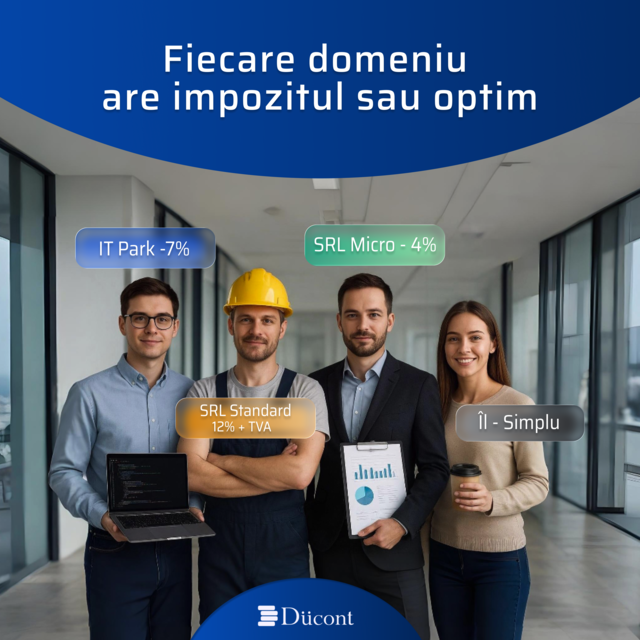
- Programming, software, IT services → IT Park (single 7% tax on revenue, salaries paid fully net, very advantageous at high revenue per employee).
- Construction, manufacturing, HORECA, trade, e-commerce, distribution → SRL standard (12% of profit + VAT) (high deductible expenses and VAT deduction on materials, equipment, inventory, etc.)
- Non-IT services (marketing, consultancy, training, design) → under 1.5M MDL/year with high margin: SRL micro (4% of revenue). Above 1.5M MDL or with high expenses: SRL standard (12% of profit + VAT).
- Freelancers / small one-person service providers → ÎI (simple at first), then switch to SRL as income and risks grow.
This topic is very broad and differs greatly case by case. If you didn’t find your situation in the examples above or you still have questions, call 022 00 22 44 and get a free tax or accounting consultation free of charge. We’ll guide you so you can start your business on the right foot!
